
Curriculum
Trainee experience
You will participate in a full-time clinical experience that includes direct patient care, observation, didactic training, and mentorship from your clinical educator and SLP colleagues. Clinical experiences will focus on the evaluation and treatment of swallowing, language, motor speech, and cognitive-communication disorders in patients with acute neurologic conditions and complex medical needs.
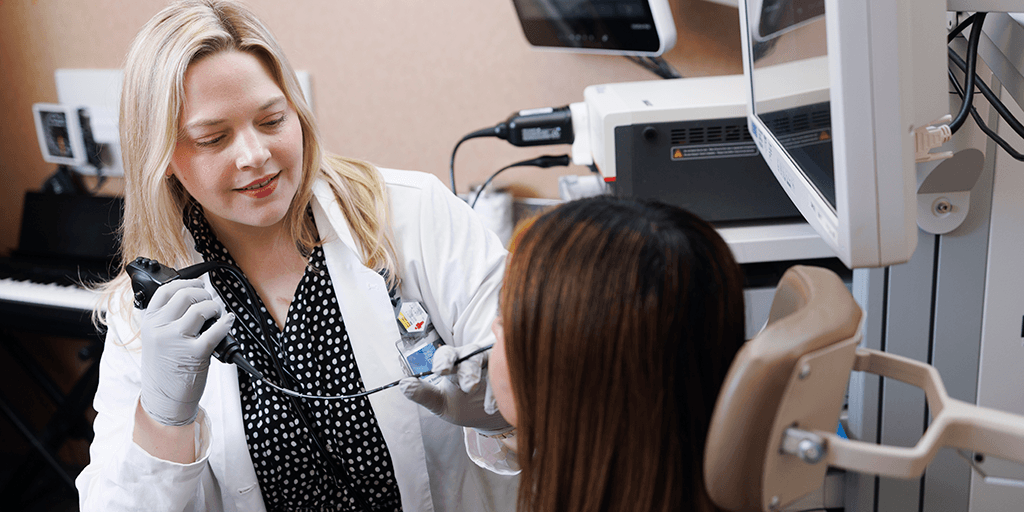
You will receive advanced training in dysphagia assessment and management, including clinical swallowing evaluations, FEES, and videofluoroscopic swallow studies (modified barium swallow studies). You will also gain experience evaluating and treating aphasia, apraxia of speech, dysarthria, and cognitive-communication disorders.
Clinical experiences will include diverse neurologic and medically complex populations, including patients with stroke, traumatic brain injury, brain tumors, seizures, encephalopathy, neurosurgical conditions, and progressive neurologic disease. Additional exposure will include patients in intensive care and those with tracheostomy, mechanical ventilation, and other complex medical needs.
Training will emphasize evidence-based clinical decision-making, interdisciplinary collaboration, patient and caregiver education, and discharge and rehabilitation planning across the continuum of care.
Additional opportunities include participation in research and quality improvement projects, interdisciplinary rounds and educational activities, and graduate student learning. You will have access to Mayo Clinic resources, including a laptop, PubMed, and Mayo Clinic libraries.
Clinical training and rotations
The fellowship experience will begin with observation, orientation, and didactic training and will progressively transition to independent clinical practice. Per ASHA standards, ongoing mentoring, observation, guidance, and assessment will be provided by a clinical educator who holds ASHA credentials.
Clinical training will include opportunities to observe and collaborate with specialists across the continuum of neurologic and acute care. Rotations may include respiratory therapy, critical care medicine, physical and occupational therapy, ENT speech-language pathology, ENT providers, and other relevant specialties. These experiences are designed to strengthen interdisciplinary collaboration and expand understanding of the medical management of patients with complex neurologic, swallowing, communication, and cognitive needs.
Schedule and hours
The Neuro/Acute Care Speech-Language Pathology Fellowship is a full-time position consisting of four, 10-hour shifts per week, including one weekend day. Fellows will also participate in the department’s scheduled holiday rotation. Schedules may vary based on clinical and educational needs.
Additional educational and professional development opportunities may be available outside of scheduled clinical hours, including Lung Transplant Rounds, Neuro SLP Rounds, General Grand Rounds, and research meetings.
Department and faculty
The Speech Language Pathology Clinical Fellowship is coordinated and taught by the speech pathologist staff and consulting staff from Mayo Clinic's Department of Neurology. Faculty members are chosen for their commitment to teaching, as well as their clinical practice and research. Many have published and lectured extensively and are highly regarded in their fields.
Department and faculty
About the faculty
Program Director: Kelly J. Trumpatori, M.S., CCC-SLP, is the supervisor of Speech-Language Pathology within the Department of Neurology at Mayo Clinic in Arizona, and is an instructor of speech pathology. She brings more than 20 years of experience as a medical speech-language pathologist, with a clinical background spanning acute care, critical care, and neurologic rehabilitation. Her areas of clinical interest include dysphagia, medically complex and critically ill patient populations, tracheostomy and ventilator management, FEES and videofluoroscopic swallow studies (VFSS), and respiratory muscle strength training.
Clinical education and mentorship have been an important part of Kelly’s career. She has supervised clinical fellows and graduate student interns, mentored practicing clinicians in advanced clinical competencies, and developed educational programs for students and multidisciplinary healthcare professionals. At Mayo Clinic, she has led educational initiatives in respiratory muscle strength training, tracheostomy, swallowing and communication, and medical speech-language pathology, and currently serves as Chair of the Enterprise Education Committee for Speech-Language Pathology across all Mayo Clinic sites.
As Program Director for the Clinical Fellowship Year program, Kelly is committed to creating a supportive and challenging learning environment where new clinicians can build confidence, strengthen their clinical reasoning, and develop their professional identity. She values individualized mentorship, collaboration, curiosity, and progressive independence, with the goal of helping each fellow transition from graduate clinician to a confident, thoughtful, and compassionate speech-language pathologist.
Assistant Program Director: Lauren Orszulak, M.S.,CCC-SLP, is a medical speech-language pathologist at Mayo Clinic in Arizona specializing in acute care. She provides comprehensive evaluation and treatment services for hospitalized patients with dysphagia, cognitive-communication disorders, aphasia, and motor speech disorders. Her clinical interests include Fiberoptic Endoscopic Evaluation of Swallowing (FEES) and the management of medically complex patients. Lauren earned her Master of Science in Speech-Language Pathology from Boston University.
Lauren also serves as the Program Director for SLP Clinical Rotations within the Neurology department.
Medical Director: Tamra I. Ranasinghe, M.B.B.S., F.A.H.A., is a vascular neurologist at Mayo Clinic in Phoenix, Arizona, specializing in stroke and cerebrovascular disease. He is an Assistant Professor of Neurology and Program Director of the Vascular Neurology Fellowship at Mayo Clinic in Arizona.
Dr. Ranasinghe completed his neurology residency at West Virginia University, where he served as Chief Resident, followed by fellowship training in vascular neurology and an NIH StrokeNet fellowship at the University of California, San Diego.
Dr. Ranasinghe evaluates and treats patients with acute ischemic stroke, transient ischemic attack, hemorrhagic stroke, and other complex cerebrovascular disorders. He has a particular clinical interest in cardioembolic stroke, including atrial fibrillation, PFO closure, left atrial appendage closure, and other conditions at the intersection of cardiovascular and cerebrovascular medicine. He co-leads the Heart and Brain Clinic in collaboration with interventional cardiology.
Dr. Ranasinghe is academically active and productive, with involvement in clinical research and trials. He is actively involved in the education and mentorship of medical students, residents, and vascular neurology fellows.
Andrea Bonk, M.S. CCC-SLP, is a medical speech-language pathologist at Mayo Clinic Hospital in Arizona, where she has provided comprehensive evaluation and treatment for patients in the inpatient hospital setting since 2012. Her clinical practice focuses on dysphagia management and communication disorders in medically complex patients, with an emphasis on individualized, evidence-based care.
Andrea earned a Master’s degree in Speech-Language Pathology from California State University, Northridge (CSUN) in 2006. Following graduate school, she completed her Clinical Fellowship at Marianjoy Rehabilitation Hospital, where she remained for six years. There, she gained valuable experience working with individuals with complex neurological, medical, and rehabilitation needs.
At Mayo Clinic, Andrea collaborates closely with physicians, nurses, dietitians, therapists, and other members of the interdisciplinary team to provide patient-centered care and support optimal outcomes.
Michelle Foy, M.S., CCC-SLP, is a medical speech-language pathologist at Mayo Clinic in Phoenix, Arizona, specializing in the evaluation and management of dysphagia and tracheostomy care in medically complex adult inpatients. Prior to joining Mayo Clinic, she spent several years in long-term acute care, providing specialized communication and swallowing rehabilitation for patients with chronic ventilatory dependence.
Michelle's clinical interests include complex and artificial airway management, the impact of tracheostomy and mechanical ventilation on swallowing and communication, aerodigestive relationships, and early communication interventions for critically ill, ventilator-dependent patients. She is also passionate about mentoring graduate students and clinical fellows.
Michelle earned her B.A. in Communication Sciences and Disorders from the University of Maine in 2004 and her M.S. in Speech-Language Pathology from the MGH Institute of Health Professions (now Mass General Brigham University of Health Professions) in Boston, Massachusetts, in 2006.
Carissa Moorhead, M.S., CCC-SLP, is a medical speech-language pathologist with eight years of experience in the field, including four years practicing in the acute care setting at Mayo Clinic in Arizona. Her clinical areas of expertise include cognition, communication, and dysphagia with specialized experience in FEES and VFSS in medically complex and critically ill patients. In addition to clinical practice, she assists with mentoring graduate students and participates in multidisciplinary collaborative groups within the hospital.
She received her master's degree in Speech-Language Pathology from Midwestern University-Glendale in 2018 and completed her graduate externship at Mayo Clinic in Arizona. Following graduation, she spent five years working at a Level I Trauma and Comprehensive Stroke Center before returning to Mayo Clinic in 2022.
Jenna Cecil, M.S., CCC-SLP, is a medical speech-language pathologist at Mayo Clinic in Arizona with eight years of experience providing evaluation and treatment services across hospital settings throughout the Valley. Her clinical experience includes working with medically complex patients and collaborating with interdisciplinary teams to provide individualized, evidence-based care.
Jenna’s clinical interests include the evaluation and management of swallowing disorders, with a particular focus on instrumental swallowing assessments, including Fiberoptic Endoscopic Evaluation of Swallowing (FEES) and Video Fluoroscopic Swallow (VFSS) studies. She strives to build meaningful connections with her patients and provides individualized care that supports their safety, independence, and quality of life.
Abby Ward, M.A., CCC-SLP, is a medical speech-language pathologist with experience evaluating and treating adults with swallowing, speech, language, and cognitive-communication disorders. Her clinical interests include dysphagia, aphasia, dysarthria, apraxia of speech, and cognitive-communication disorders. She has worked with medically complex patient populations, including individuals with neurologic conditions, head and neck cancer, tracheostomies, and other complex medical needs.
Abby’s experience spans both acute care and outpatient settings and includes instrumental swallowing evaluations, as well as comprehensive assessment and treatment of speech, language, and cognitive-communication disorders. She particularly values helping patients improve the safety and confidence of their swallowing and supporting functional communication and connection with family and care teams. Abby earned her Master of Arts in Speech, Language, and Hearing Sciences from San Diego State University in 2024.
Facilities
Mayo Clinic's Arizona campus has two main locations. Mayo Clinic’s location in Phoenix is home to the state-of-the-art Mayo Clinic Hospital, the first hospital entirely designed and built by Mayo Clinic. It has been recognized several times by Phoenix magazine as the "Best Hospital in Phoenix." Services in numerous medical and surgical disciplines are provided, including outstanding programs in cancer treatment and organ transplantation.
Mayo Clinic’s location in Scottsdale is centered around a beautiful, five-story outpatient clinic. This modern facility contains extensive exam rooms, an outpatient surgery center equipped for general anesthesia, a full-service laboratory, pharmacy, patient education library, endoscopy suite, and a 188-seat auditorium for patient, staff, and student education programs.
Evaluation
Mayo Clinic School of Health Sciences uses these evaluative tools within the fellowship:
- Demonstration of skills
- Self-assessment exercises
- Learning outcomes and assignments from didactic sessions
- Faculty reviews
- Optional academic project
Evaluative tools will include learning outcomes and assignments from didactic sessions, demonstration of skills, self-assessment exercises, faculty reviews, and guidance on an optional academic project.
Throughout the year and upon completion of the clinical fellowship, the clinical educator will document and verify clinical skills using the Clinical Fellowship Report and Rating Form and the Clinical Fellowship Skills Inventory per the standards set forth by ASHA.
Completion and certification
Successful completion of the clinical fellowship experience will be confirmed by your clinical educator per the requirements of ASHA to obtain the Certificate of Clinical Competence in Speech-Language Pathology, along with state licensure requirements to move forward from provisional to full. Additionally, upon successful completion of the fellowship, you will receive a Certificate of Completion from Mayo Clinic School of Health Sciences.