
/prod01/channel_2/media/mccms/content-assets/academics/residencies-and-fellowships/cardiovascular-pathology-fellowship-minnesota/meet-our-trainees/Swanson-Amy-WF5602390-0332.jpg)
Amy Swanson, M.D.
Program Director for Cytopathology Fellowship
Consultant in Laboratory Medicine & Pathology
Assistant Professor of Laboratory Medicine & Pathology
Email: swanson.amy3@mayo.edu
/prod01/channel_2/media/mccms/content-assets/academics/residencies-and-fellowships/cardiovascular-pathology-fellowship-minnesota/meet-our-trainees/Meet-the-Faculty-1024X512-WF5602390-0329.jpg)
Mayo Clinic's Department of Laboratory Medicine and Pathology in Rochester, Minnesota, is one of the largest clinical laboratories in the world. A highly skilled team of medical professionals including physicians, scientists, medical technologists, medical technicians, lab assistants, biologists, chemists, microbiologists, geneticists, and other specialists work collaboratively.
Mayo Clinic Laboratories is the referral center for Mayo Clinic. Mayo Clinic Laboratories specializes in esoteric laboratory testing for health care organizations throughout the United States and around the world. Mayo Clinic Laboratories' mission is to support the local delivery of laboratory services through the provision of exceptional reference laboratory services and by providing support services that facilitate and augment community integration efforts.
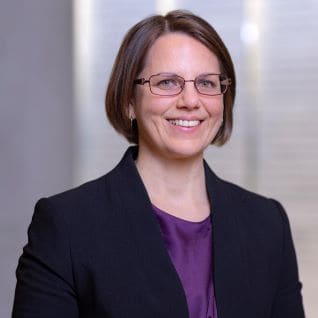 Welcome to the Cytopathology Fellowship at Mayo Clinic in Rochester, Minnesota, and thank you for your interest in our program! I am honored to serve as program director of a fellowship with diverse case material, a large group of engaged faculty, and a collaborative approach to patient care within a supportive learning environment. As someone who completed the fellowship, I know the comprehensive experience the program provides.
One of the greatest strengths is the volume and variety of cytologic specimens, from our busy in-house practice to complex consultation material. Cases range from common entities to uncommon and diagnostically challenging. Our fellows participate in all aspects of cytopathology practice, including fine needle aspiration procedures, rapid on-site evaluation (ROSE), integration of ancillary studies, and multidisciplinary collaboration with clinical and pathology colleagues. A unique aspect of our practice is the correlation between cytology and surgical pathology material, including preservation of tissue cores with smear specimens, which provides valuable opportunities to compare cytomorphology and histology.
Our curriculum emphasizes graduated responsibility and hands-on experience. Fellows progress from closely supervised sign-out early in the year to increasing autonomy and independent sign-out as the year advances, helping prepare them for independent practice in both academic and community settings. We also strive to tailor aspects of the experience to align with individual educational interests and career goals. Our fellows learn from a diverse group of faculty with varied subspecialty expertise and diagnostic perspectives. In addition to clinical training, fellows have opportunities to participate in research, educational activities, and interdisciplinary conferences throughout the year. We are proud of the well-rounded training our fellowship provides. We invite you to explore our program further and welcome any questions you may have!
Amy Swanson, M.D.
Program Director
One of the greatest advantages to training at Mayo Clinic is the approachability, accessibility, and collegiality of the faculty. Our faculty are committed to teaching and facilitating the growth of medical knowledge. Many of our faculty members have published and lectured extensively and are highly regarded in their fields.
The Division of Anatomic Pathology has over 60 pathologists with subspecialty expertise covering the entire field of surgical pathology. The division is organized around working groups dedicated to specific organ systems, but all members contribute service to general areas as well, such as frozen section lab, autopsy, and cytology.
Amy Swanson, M.D.
Program Director for Cytopathology Fellowship
Consultant in Laboratory Medicine & Pathology
Assistant Professor of Laboratory Medicine & Pathology
Email: swanson.amy3@mayo.edu
/prod01/channel_2/media/mccms/content-assets/academics/residencies-and-fellowships/cardiovascular-pathology-fellowship-minnesota/meet-our-trainees/Salomao-Diva-WF5602390-0338.jpg)
Diva Salomao, M.D.
Associate Program Director for Cytopathology Fellowship
Consultant in Anatomic Pathology
Professor of Laboratory Medicine & Pathology
Email: salomao.diva@mayo.edu
/prod01/channel_2/media/mccms/content-assets/academics/residencies-and-fellowships/cardiovascular-pathology-fellowship-minnesota/meet-our-trainees/Albadri-Sam-WF5602390-0351.jpg)
Sam Albadri, M.B., Ch.B., M.S.
Consultant in Anatomic Pathology
Assistant Professor of Laboratory Medicine & Pathology
Email: Albadri.Sam@mayo.edu
/prod01/channel_2/media/mccms/content-assets/academics/residencies-and-fellowships/cardiovascular-pathology-fellowship-minnesota/meet-our-trainees/Bell-Debra-WF2664302-0044.jpg)
Debra Bell, M.D.
Professor of Laboratory Medicine & Pathology
Consultant in Anatomic Pathology
/prod01/channel_2/media/mccms/content-assets/academics/residencies-and-fellowships/cardiovascular-pathology-fellowship-minnesota/meet-our-trainees/Bois-Melanie-1591605-3851836-0006.jpg)
Melanie Bois, M.D.
Consultant in Laboratory Medicine & Pathology
Assistant Professor of Laboratory Medicine & Pathology
Email: bois.melanie@mayo.edu
/prod01/channel_2/media/mccms/content-assets/academics/residencies-and-fellowships/cardiovascular-pathology-fellowship-minnesota/meet-our-trainees/Clayton-Amy-WF2664302-0031.jpg)
Amy Clayton, M.D.
Consultant in Laboratory Medicine & Pathology
Professor of Laboratory Medicine & Pathology
Email: clayton.amy@mayo.edu
/prod01/channel_2/media/mccms/content-assets/academics/residencies-and-fellowships/cardiovascular-pathology-fellowship-minnesota/meet-our-trainees/Hartley-Chris-WF146000-0017.jpg)
Chris Hartley, M.D.
Consultant in Laboratory Medicine & Pathology
Assistant Professor of Laboratory Medicine & Pathology
Email: Hartley.Christopher@mayo.edu
/prod01/channel_2/media/mccms/content-assets/academics/residencies-and-fellowships/cardiovascular-pathology-fellowship-minnesota/meet-our-trainees/Hrizat-Alaa-30424956-20250701.jpg)
Alaa Hrizat, M.D.
Associate Consultant in Anatomic Pathology
Email: hrizat.alaa@mayo.edu
/prod01/channel_2/media/mccms/content-assets/academics/residencies-and-fellowships/cardiovascular-pathology-fellowship-minnesota/meet-our-trainees/Huang-Yajue-WF146000-0010.jpg)
Yajue Huang, M.D., Ph.D.
Consultant in Laboratory Medicine & Pathology
Associate Professor of Laboratory Medicine & Pathology
Email: huang.yajue@mayo.edu
/prod01/channel_2/media/mccms/content-assets/academics/residencies-and-fellowships/cytopathology-fellowship-minnesota/512X512-thangaiah-30007012_202007010305.jpg)
Judith Jebastin Thangaiah, M.B.B.S., M.D.
Consultant in Anatomic Pathology
Assistant Professor of Laboratory Medicine & Pathology
/prod01/channel_2/media/mccms/content-assets/academics/residencies-and-fellowships/cardiovascular-pathology-fellowship-minnesota/meet-our-trainees/Keeney-Gary-10018115-201712111119.jpg)
Gary Keeney, M.D.
Consultant in Laboratory Medicine & Pathology
Professor of Laboratory Medicine & Pathology
Email: keeney.gary@mayo.edu
/prod01/channel_2/media/mccms/content-assets/academics/residencies-and-fellowships/cytopathology-fellowship-minnesota/512X512-meroueh-21390231_201907011116.jpg)
Chady Meroueh, M.D.
Assistant Professor of Laboratory Medicine & Pathology
Consultant in Anatomic Pathology
Email: meroueh.chady@mayo.edu
/prod01/channel_2/media/mccms/content-assets/academics/residencies-and-fellowships/cytopathology-fellowship-minnesota/512X512-Rivera-15478599_201511060817.jpg)
Michael Rivera, M.D.
Consultant in Anatomic Pathology
Assistant Professor of Laboratory Medicine and Pathology
Email: rivera.michael@mayo.edu
The Division of Anatomic Pathology is supported by full-service laboratories in histology, immunohistochemistry, molecular genetics, and cytogenetics.
Fellows are assigned dedicated faculty mentors who can provide comprehensive educational advice and personal support. Trainees meet with their mentors periodically throughout the fellowship to review progress and career goals, and ensure that their educational needs are being met. Mentors also serve as a contact point for introducing fellows and their families to Rochester, Minnesota, and the Mayo Clinic system.
Many prominent professors visit Mayo Clinic each year. They present their work during lectures and participate in hospital rounds and informal discussions with trainees. Fellows are encouraged to take full advantage of these educational opportunities.