
/360x0:1080x720/prod01/channel_2/media/mccms/content-assets/academics/residencies-and-fellowships/urologic-oncology-fellowship-arizona/mccms-urologic-oncology-fellowship-hero-WF2235531_0101.png)
Overview
The two-year Urologic Oncology Fellowship at Mayo Clinic in Phoenix, Arizona, provides fellows with a robust clinical and academic experience in urologic oncology. We provide a multidisciplinary approach to patient care, and fellows will have the opportunity to collaborate with experts in medical oncology, radiation oncology, pathology, and radiology, among others.
This team-based approach not only strengthens the clinical experience but also provides rich research opportunities in the areas from advanced bladder cancer treatments to innovative surgical techniques.
fellow position available each year
hospital in Arizona for 13 consecutive years (U.S. News, 2025-2026)
year fellowship
Accreditation, certification, program history
Accreditation
The Urologic Oncology Fellowship at Mayo Clinic is accredited by the Society of Urologic Oncology.
Certification
Fellows must take the Oncology Knowledge Assessment Test every year of the fellowship. Fellows will receive the SUO certification after completion of the program
Program history
The Urologic Oncology at Mayo Clinic's campus in Arizona begins in July 2027.
Application process
Positions
One position is available on a competitive basis each year in the Urologic Oncology Fellowship at Mayo Clinic’s campus in Phoenix, Arizona.
Qualifications
To be eligible for the Urologic Oncology Fellowship, you must expect to complete a residency program in urology and be eligible for an Arizona medical license.
This includes qualified candidates from outside the U.S. and Canada who meet the following criteria:
- Have graduated from an international medical school recognized by the World Directory of Medical Schools
- Meet all visa sponsorship requirements
- Are certified by the Educational Commission for Foreign Medical Graduates
- Are eligible for a Minnesota medical license, which requires a minimum of one year of accredited residency or fellowship training in the U.S. or Canada
Also see general admissions requirements.
How to apply
The academic year begins July 1.
Applications to the Urologic Oncology Fellowship are accepted November through January.
- All applicants to the Urologic Oncology Fellowship must register with the Society of Urologic Oncology (SUO)
- Submit a completed Society of Urologic Oncology (SUO) Fellowship Application
Applications must include the following supporting documentation:
- Curriculum vitae and bibliography
- Personal statement of professional goals
- Valid ECFMG certificate, if applicable
- Three original letters of recommendation from physicians or faculty members who are thoroughly familiar with your work; one of these should be from your residency program director
Applicants who eventually match to the Urologic Oncology Fellowship will be required to submit to the Mayo Clinic School of Graduate Medical Education the following documentation as a requirement for appointment:
- Copy of diploma from your medical school
- Dean's letter sent directly from your medical school to the education coordinator of the Urologic Oncology Fellowship
- Official final medical school grade transcript indicating degree earned and date conferred (provide certified or notarized English translations of documents originally written in a language other than English)
- Official test transcripts for all applicable examinations: USMLE, LMCC, COMLEX, NBOME, FMGEMS, FLEX or NBME
- Copy of your completion certificate from each of your prior residency and/or fellowship training programs
Interviews are conducted in the spring of the year preceding the appointment year and are offered to those applicants deemed most competitive.
Appointments are made by Mayo Clinic School of Graduate Medical Education based on results from the Society of Urologic Oncology Fellowship Match which is sponsored by the American Urological Association.
Curriculum
The Urologic Oncology Fellowship program is a two-year training program that offers comprehensive, hands-on training in the management of patients with urologic cancers and research. During the first year of the fellowship, you have the opportunity to perform and lead basic science or clinical research. The second year is dedicated to clinical rotations. The program is designed to provide the fellow with a rich, diverse educational experience to the fellow, balancing clinical training, research opportunities, and didactic learning.
Clinical training
Clinical rotations focus on minimally invasive and open approaches to the full spectrum of urologic oncology cases. Fellows have full responsibility for running inpatient and outpatient urology services and actively participate in surgery.
Experience with urologic oncology clinical trials and translational research is also available, providing exposure to the medical and surgical aspects of treating advanced urologic malignancies, especially renal cell carcinoma, bladder cancer, prostate cancer, and testicular cancer.
Rotations, didactic training, call frequency
Rotations
You are paired for one-to-one rotations with urology faculty members who have high-volume practices devoted to urologic oncology, typically for an eight-to-12 week rotation.
Didactic training
Clinical conferences, seminars, journal clubs and one-on-one instruction are integral parts of this fellowship.
Call frequency
Urologic oncology fellows are not required to take call.
Conferences, research opportunities, teaching opportunities
Conferences
The Urologic Oncology Fellowship includes weekly, monthly and bimonthly conferences and lectures. Fellows will participate in the following conferences:
- Bimonthly Multidisciplinary GU Oncology Tumor Board
- Monthly Journal Club (expected to present twice annually)
- Monthly Didactic Lecture Series
- Weekly Imaging and Pathology Case Conference
- Monthly Morbidity and Mortality Conference
Research opportunities
The first year of the fellowship is dedicated entirely to research and professional development. The year is structured to provide fellows with mentored research experience in clinical trial development, translational science, and outcomes research. The goal is to develop future physician-scientists and academic leaders in urologic oncology.
Teaching opportunities
Fellows will have the opportunity to interact and participate in teaching residents during the clinical year.
Evaluation
To ensure that you acquire adequate knowledge and develop the appropriate technical skills to meet program expectations, your performance is monitored carefully during the program. You are evaluated formally by the supervising faculty member after each clinical rotation, and you will meet with the program director to review these evaluations. In addition, you will also regularly evaluate the faculty to ensure that your educational needs are being met.
Belonging
At Mayo Clinic, we foster an inclusive working environment and embrace the diversity of all our trainees, faculty, staff, and patients. Our Office of Belonging offers tremendous resources to support our mission of maintaining a welcoming atmosphere for all our employees, including our learners. We strive to provide culturally appropriate care and do our part to reduce healthcare disparities.
/0x0:1440x480/prod01/channel_2/media/studio-sites/mccms-reference-guide/1440X4801573348-380187-2-0024.jpg)
Video: See yourself at Mayo Clinic
5:33
Department and faculty
The Department of Urology at Mayo Clinic's campus in Phoenix, Arizona is composed of approximately 14 faculty members. Among these, the department currently has five full-time urologic oncology faculty members, all of whom are experts in the nuanced field of urologic oncology.
In addition to caring for patients in their clinical practices, Mayo Clinic's faculty is committed to teaching and facilitating the growth of medical knowledge. Our faculty members have published and lectured extensively and are highly regarded in their field. Fellows have direct access to these urology specialists during training in the Urologic Oncology Fellowship.
Advisors and mentors, visiting professors
Advisers and mentors
You select a faculty adviser from the urology physician staff who can provide comprehensive educational advice and personal support. Trainees meet with their advisers periodically throughout the fellowship to review progress and career goals and ensure that their educational needs are being met.
Visiting professors
Each year, the Department of Urology hosts prominent world-renowned urologists as visiting professors to Mayo Clinic. They present their work during lecture events, participate in hospital rounds and lead discussions with trainees during formal case presentations. You are encouraged to take full advantage of these educational opportunities.
Wellness initiatives
As a trainee, your physical and mental health are priorities to Mayo Clinic and the department. Trainees have access to several resources to promote well-being, as well as time off clinical duties to attend appointments.
- Fitness centers
- Groups on campus
- Well-being
Fitness centers
 As a resident or fellow at Mayo Clinic in Arizona, you have access to an exclusive learners-only gym and wellness center conveniently located in Phoenix. Additionally, Mayo Clinic residents or fellows at our three campuses get discounted membership fees to area gyms through PerkSpot, the Mayo Clinic employee discount program.
All Mayo employees, including Arizona learners, can also sign up to take live virtual fitness classes or view recorded fitness classes offered by the Dan Abraham Healthy Living Center (DAHLC).
Groups on campus
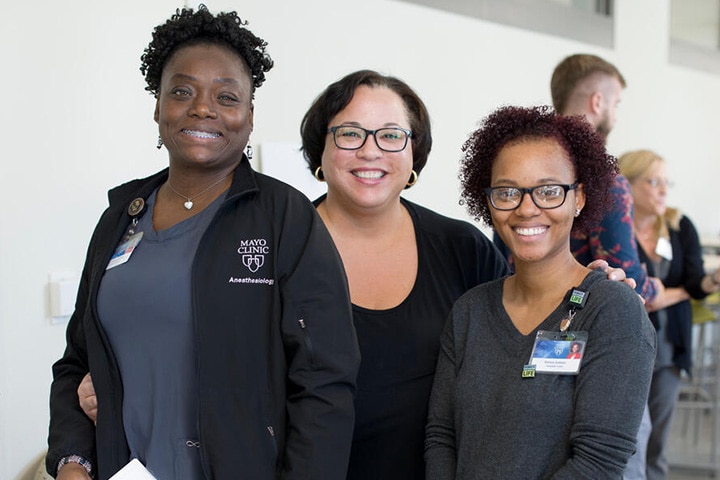 Opportunities to join a variety of groups on campus provide regular social activities and can help enhance your training while connecting with a broad group of peers.
Trainees have the opportunity to join a Mayo Employee Resource Group (MERG) at any time during their training program. MERGs are employee-led affinity groups to promote belonging, increase cultural awareness, and foster an environment of respect and inclusivity. Any Mayo Clinic employee can join a group of interest and choose their level of involvement.
Well-being
 The Office of Academic Support and Well-Being provides resources to promote academic, emotional, social, cognitive, financial, and physical well-being. Career and academic services include academic advising, peer tutoring, and accommodations for learners with disabilities or health conditions. Mental health services, counseling, interview practice, and a variety of enrichment sessions on topics like budgeting, resiliency, and stress and burn-out are also available through the Academic Support and Well-Being office.
More from Mayo Clinic School of Graduate Medical Education
/0x0:512x512/prod01/channel_2/media/mccms/content-assets/academics/residencies-and-fellowships/3319834_0363-512X512.jpg)
Choosing Mayo Clinic
/0x0:512x512/prod01/channel_2/media/mccms/content-assets/shared-documents/campus-AZ-3180811-0001-pic-tile.jpg)
Phoenix/Scottsdale, AZ
Campus and community
/0x0:512x512/prod01/channel_2/media/studio-sites/mccms-reference-guide/512X5121676671_3824027_0010_C.jpg)
Stipend and benefits
/0x0:440x220/prod01/channel_2/media/mccms/content-assets/campus-amp-community/arizona/440X220_sidebar-mayo-clinic-phoenix-arizona-is453080663.jpg)