
Meet Jeeva Palanisamy, M.D.
What drew you to Mayo Clinic for your residency training?
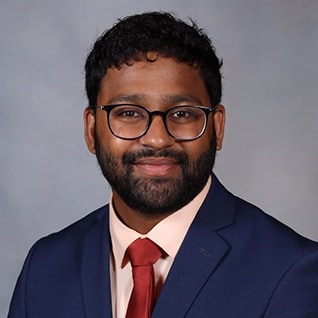 When I was selecting a residency program, the characteristic I prioritized highest was the happiness of the current residents. I knew that a lot of the programs on my list would provide great training, but I wanted to know that residents were well taken care of. When I met the current residents and chiefs, I saw that they were friends and not just colleagues, had bright smiles even when coming straight from an inpatient shift and heard of all of the program’s benefits otherwise. Having trained here, I can confirm what I heard multiple times during our virtual second looks: “this was the best choice I made both personally and professionally”.
What do you do for fun in Rochester?
I am a big fan of reading, so I will find a lot of random places to sit with a book. To that end, I really enjoy reading at our breweries in town (5 of them!), in some of the beautiful upper-level window-facing spots on our downtown campus, and outdoors at some of our many parks. As a big foodie, the number of excellent taco trucks and Mexican food options we have is incredible. Basketball is a big part of my life, and the pickup basketball at the Rochester Athletic club (5am at the RAC) is some of the most competitive ball I’ve played! We also have some local gems like the Rochester baseball team, Rochester public library, Pop’s Art theater, and several frisbee golf courses.
Is there anything that surprised you about Mayo Clinic?
Having grown up in Minnesota, I always heard tales of the Mayo Clinic as this distant place filled with experts in suits who looked down on all other medical care. Though we do wear suits in the outpatient setting, and there are a ton of world-renowned experts here, this could not be farther from the truth! Every single person here is humble, kind, willing to teach, and always seeking out the best way to care for patients. There is an openness to working across institutions and going the extra mile, with high standards across the institution for all staff.
What opportunities exist to participate in procedures and develop POCUS skills during your training?
Procedures are a built-in piece to many of our rotations. For inpatient procedures, the medical and cardiac ICU rotations put a lot of opportunities in front of interns first. With POCUS, we have ultrasound machines available throughout the hospital for use on any rotation for a variety of purposes. We also have formal education with the chiefs and other faculty, including options for electives even past that. On the outpatient side, we rotate through the IM procedure clinic and can also do elective time in there. We definitely get a good variety of both inpatient and outpatient procedures, and a number of eager teachers as well.
How has residency prepared you for a career in primary care while supporting your individual interests?
I am a part of the incredible primary care track here! Through this program, I have exemplary mentors to help guide me to a career in primary care. There are primary-care focused electives as well, influenced by our interests. For example, I spent time in Gynecology procedures, addiction psychiatry, the Indian Health Services in Winslow, Arizona, and more. Mentors are assigned to me and help support various aspects of my development – outpatient clinic performance, research, job hunting, etc. We have a wide variety of faculty to staff our continuity clinic too, from physicians in executive health, vascular medicine, fibromyalgia clinic, community medicine. I quickly found that any of these mentors would readily answer texts or go to bat for me on any issues I have had.